From stone to lime
Uses of lime
FROM BUILDING TO FARMING
An everyday material: from building to food, from farming to the white that lights up Ostuni.
Lime in building
Types of lime
Quicklime, produced in the kilns, is a white solid that reacts violently on contact with water, releasing intense heat; it is not used directly in building, but is the basis of every later process. Adding water gives slaked lime, as a powder or a paste, the most widespread form for plasters, mortars and paints. Quicklime and slaked lime are both types of air lime, which hardens only in contact with air. Different is hydraulic lime, able to harden even in the presence of water thanks to its silicates; among its varieties, natural hydraulic lime (NHL) is the most valued in restoration for its compatibility with historic masonry. Lime putty (grassello), slaked lime left to mature in water for months or years, gains plasticity and workability, becoming the material of choice for fine plasters and frescoes. Lime milk, a very diluted suspension, is used as whitewash, as an agricultural disinfectant and in water treatment.
Mortars, plasters and whitewash
Lime mortar, made by mixing slaked lime with sand or other aggregates, is the historic binder of masonry: it is used for bedding stones, pointing joints and consolidating decayed walls. Compared with cement, it is more breathable and compatible with old buildings, which cement instead tends to damage by trapping moisture.
Traditional lime plaster is applied in three progressive coats — render, float coat and skim — each with its own function and grain size, and needs slow drying so the lime can carbonate and harden properly. Whitewash, the simplest and most widespread finish in the Mediterranean, is obtained by spreading thin veils of lime milk: besides letting walls breathe, it is biocidal against moulds and bacteria, reflects sunlight and can be removed without harming the support; the layering of coats over time creates slightly undulating surfaces that reflect light in a unique way.
Finishes and floors
Among the finest finishes, lime stucco is made from matured putty enriched with marble powder, polished to a smooth, semi-glossy surface. Marmorino, similar in composition, differs in its coarser, more textured grain. Tadelakt, a traditional technique from Morocco, involves intense working with river stones and a final treatment with black soap that makes the surface waterproof.
Historic floors too rely on lime: the lime screed (battuto di calce), the oldest, is a compacted paste polished until smooth and waterproof. Cocciopesto, of Roman origin (the ancient opus signinum), combines lime and ground brick for moisture-resistant surfaces. In Puglia the chianche floor is common — slabs of local limestone bedded in lime — typical of rural building and old towns. The wear of footfall and the patina of lime have over time given these floors a natural sheen of great beauty. In Venice, instead, the Venetian terrazzo was born, with fragments of marble or glass bound by hydraulic lime and polished to a mirror finish. Finally, the tessellated mosaic, in use from Roman and early-Christian times to the Renaissance, was laid on several coats of lime mortar of decreasing grain size. Many Roman-era mosaics made with this technique have come down to us intact, such as those kept in the nearby National Archaeological Museum of Egnazia.
Properties, restoration and sustainability
Lime has notable properties that bring healthiness to interiors: it is highly breathable, letting moisture evaporate, and at the same time hygroscopic, able to absorb and naturally regulate water vapour in the air. It also has a high alkalinity, which inhibits the spread of moulds and bacteria, and a marked reflectance, which lets it scatter sunlight into the narrow alleys of the old towns and bring coolness inside buildings.
In restoration, lime is the reference material, for its compatibility with old masonry, its breathability, the reversibility of the work and its proven durability; the improper use of cement in the twentieth century instead caused serious damage to the historic heritage. Lime also stands out for sustainability: over time it reabsorbs the carbon dioxide released during firing, making it almost climate-neutral, unlike cement.
Lime is not merely a building material: it is the building memory of the Mediterranean, an age-old knowledge that binds the stone, protects the masonry and gives walls back their light.
Ostuni’s building tradition
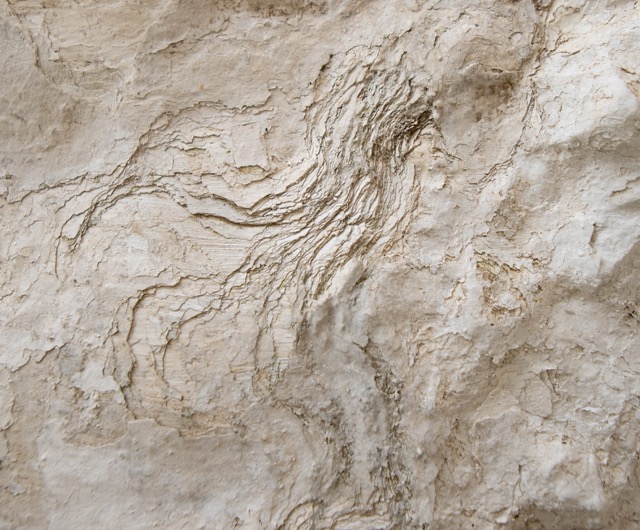
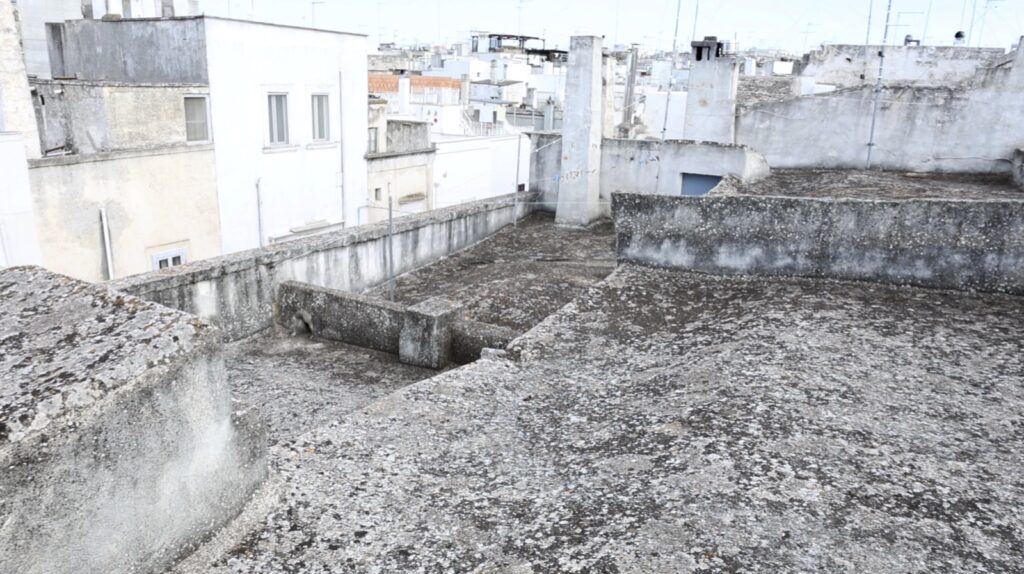
L’ašchëtë or jašchëtë: «The original meaning is “cocciopesto”, a kind of flooring for rooms and roofs, used also as plaster by the ancient Romans, as can be seen in some buildings unearthed at Pompeii. Our builders used to prepare (no longer today, though some aštrëchë remain) a mix of small pebbles (rascidde), dust and lime, levelled over a layer of crushed tiles (la tèjëla). Then the workers, with small rectangular boards strapped under their shoes (li tavuleddë dë l’ašchëtë), little longer than the shoes themselves, would pound the mix for days on end; often wetted, it was beaten with the màgghjë — a club. Finally lime, dust and tiles were mixed together and the surface was smoothed. It was all covered for a time with plants of mùcchjë — mastic, myrtle, phillyrea — or d’àttumë — thyme — or with rëstucceë — stubble — to protect the floor from the weather (editor’s note: to avoid too rapid a set of the cocciopesto under direct sun, which would cause cracking). Since the work was waterproof, it was used especially for terraces, hence the secondary meaning of “terrace”. L’ašchëtë could be called a “beaten floor”».
From T. Nobile, Dizionario del dialetto ostunese, ed. Congedo, Galatina, 1999, vol. I, p. 100.
The cazzafitta: «Plaster, but it also means rubble; (…) Three coats are distinguished, trè mmanë: the first coat, il rinzaffo pë śgrussà, ‘to rough out’, la sëconda mana ‘the float coat’ pë spianà ‘to level, to smooth’, lu liscë o lu fine ‘the skim’ that completes and finishes the work. When the wall surface is fairly regular there are do manë ‘two coats’, doing without the rinzaffo. Pë dda la cazzafitta ‘to plaster’ one uses the cucchjara, lu sprëviérë, lu fracassë e la stascèdda.»
From T. Nobile, Dizionario del dialetto ostunese, ed. Congedo, Galatina, 1999, vol. I, p. 173.
Lime in food
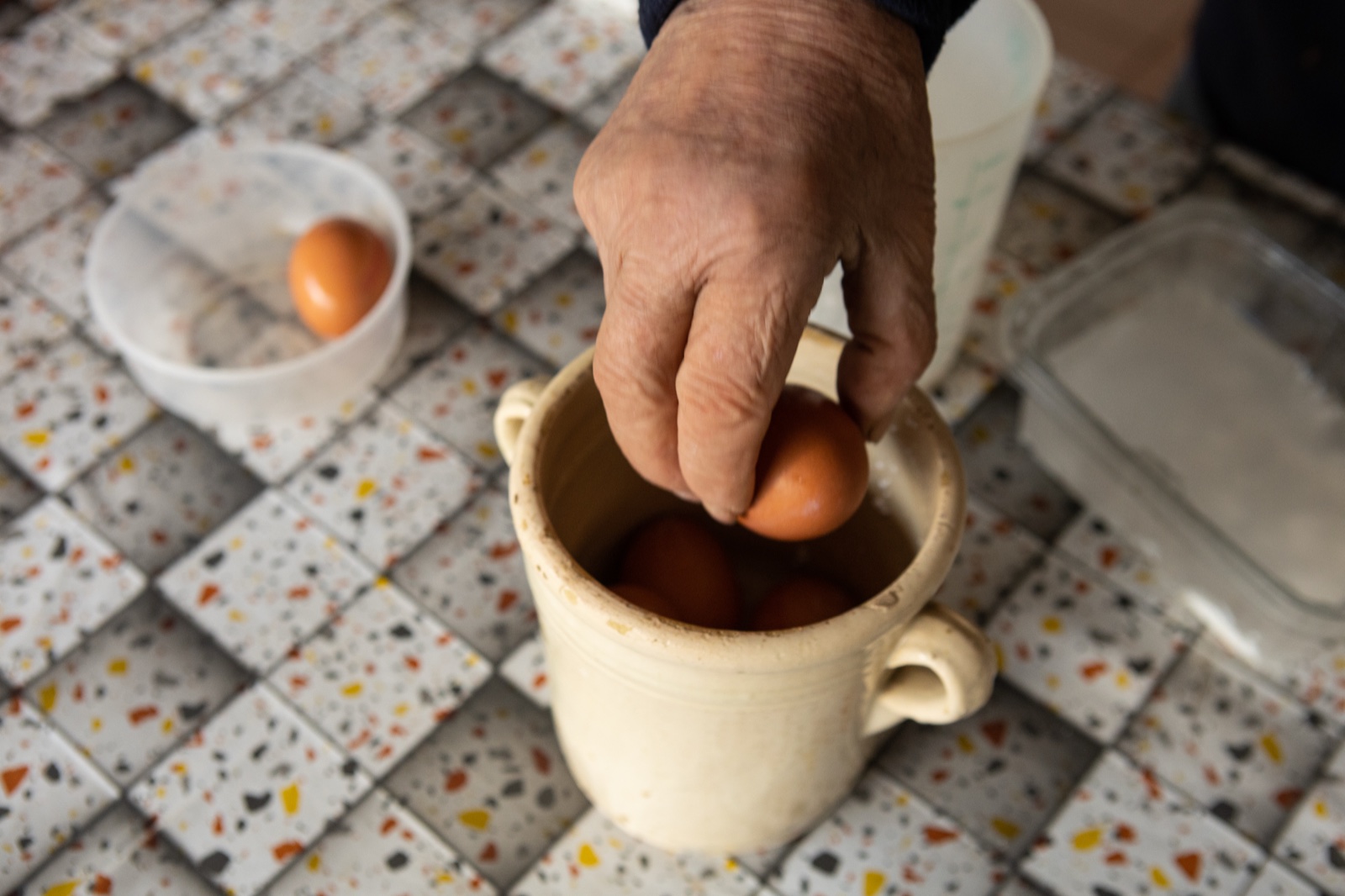
In food tradition, lime long played the role of a preservative. One example is the recipe for “eggs under lime”, handed down in the notebook of Vincenzina Anglani (1888-1975). “How to preserve eggs: choose the eggs and lay them carefully, the narrower end down, in an earthenware jar. When the jar is full, fill it with a mixture of six or eight grams of slaked lime in a litre of water and cover the eggs with this water. Then close it well so that no light gets in, and do not touch them until the time comes to use them”.
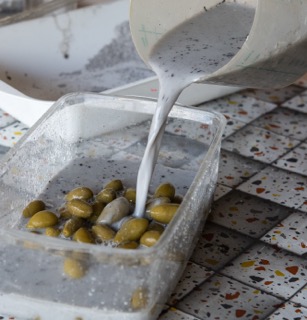
“olives in lime” too follow a similar process, with a paste of water, lime and ash, followed by a long rinse and a flavouring in aromatic brine with water, salt and various herbs such as wild fennel, anise, lemon peel, sprigs of myrtle and bay.
Food-grade lime is also used as an acidity regulator, as in Mesoamerican nixtamalization, where maize is soaked and cooked in an alkaline solution of ash and lime — a treatment that improves its texture and flavour and frees vitamin B3, preventing pellagra. As calcium hydroxide (E526), lime is still used as a regulating additive in various foods.
Lime in farming
In agriculture, lime serves mainly to correct the acidity of soils: bringing the pH back towards neutral, it frees nutrients such as phosphorus, potassium and magnesium otherwise locked in the soil. It also supplies calcium to plants, reduces aluminium and manganese toxicity in acidic soils, and stimulates the activity of beneficial micro-organisms. Physically, lime promotes the flocculation of clay, binding the finest particles into larger structures: the soil thus becomes softer and more porous, with benefits for drainage, oxygenation and workability.
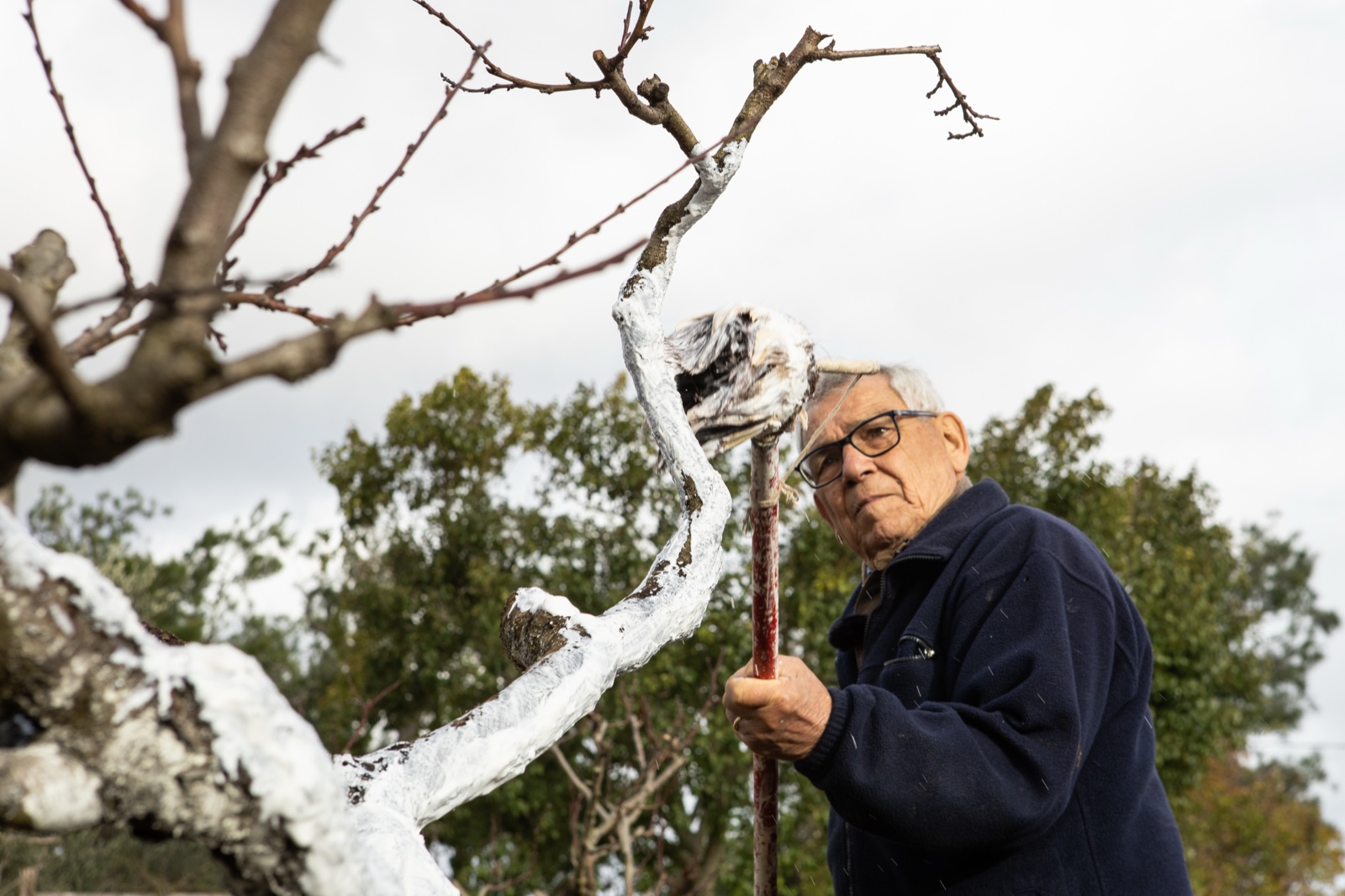
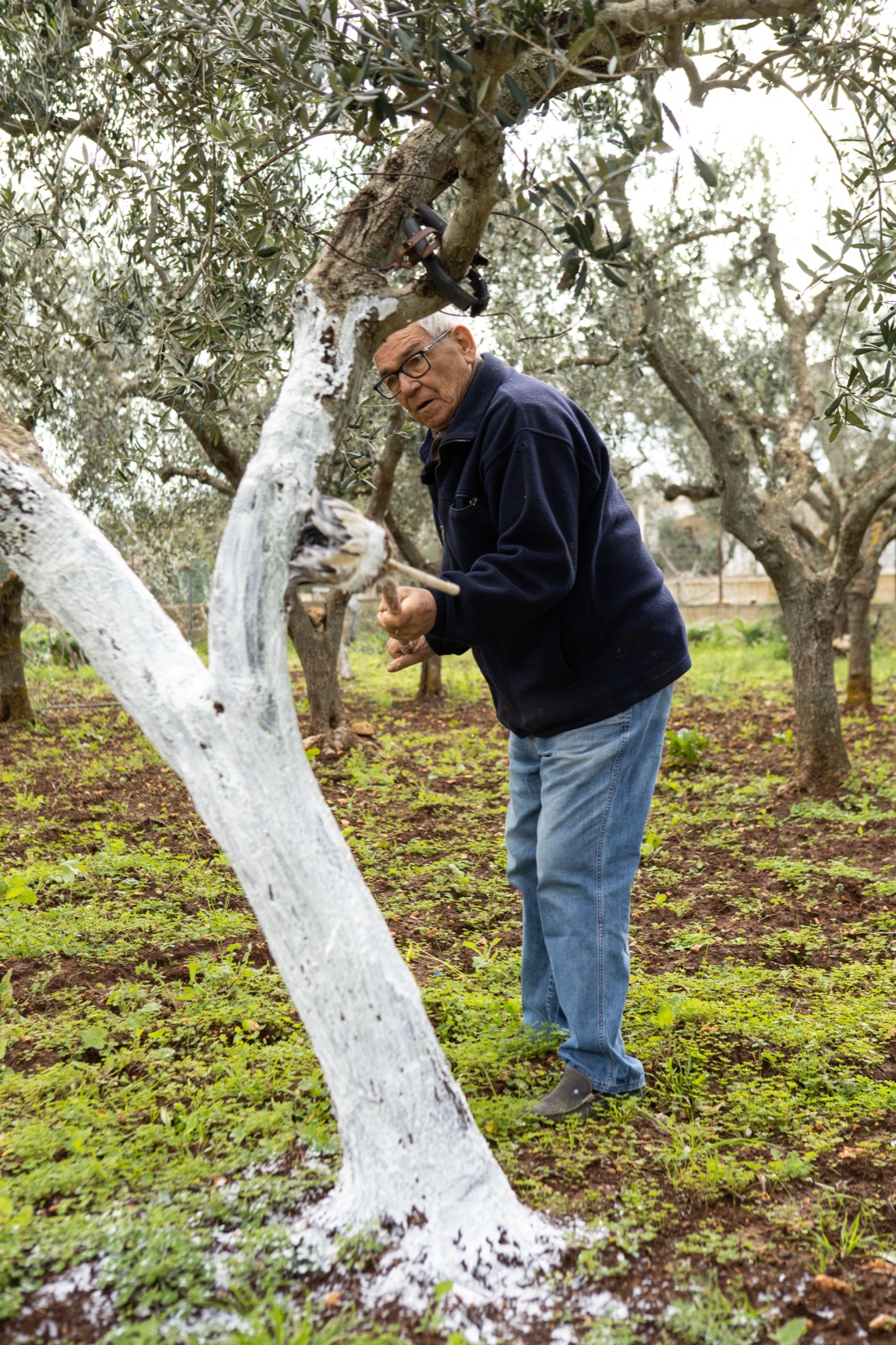
An age-old farming practice is the whitewashing of trunks with lime milk: the white coating reflects the sun, protecting the bark from overheating and temperature swings, while its high alkalinity deters insects, fungi and overwintering parasites.
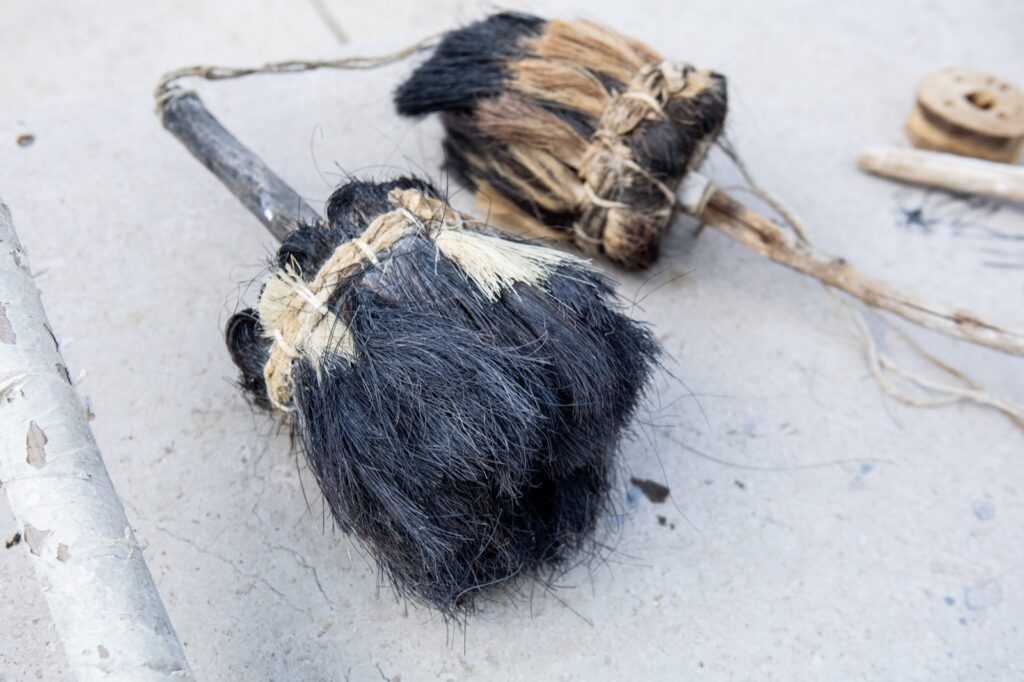
Lu scuparièddë
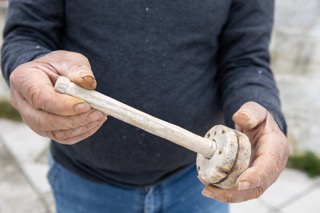
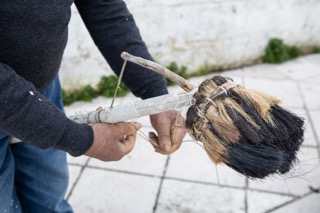
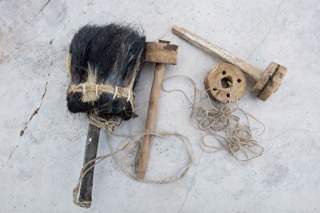
«Lu scuparièddë» — the whitewasher’s great brush — was made by hand by «Lu bianghetóre» with: the ferrule (ròzzëla) of dried wild-fig wood, horsehair from a horse’s tail (li penneddère), twine, a small stick of olive or almond wood (lu zippë), a large needle (achecèdda) and pig bristle (la zètela).
Lu Scuparièddë
by Beniamino Farina
La rozzela ancora sana,
lu zippe ‘ncurcate,
la zetela tesa e lu pilu ammusciate.
‘Nterra stava scettate
nu scupariedde de l’anne passate.
Lu stà pigghjava, lu vuleva spegghjà,
cu chera rozzela nande n’era crià.
A lla ‘mbrivvisa, sentibbe parlà:
— «Lasseme stà, na me spegghjà,
li Stunise senoca de me s’ona scurdà.
T’arrecuerde li tiembe passate,
quanda cangia ‘nguerpe a llu parete
de jnda alla Terra ime menate?
Tanne chjù vianche era lu paise,
e li Stunise s’arrecchescira,
pe tanda furastiere ca venira.
Nu monumente m’ona ffà.» —
Lu pegghjebbe, l’allescebbe,
fu cundende e lu pilu ‘nzeppò,
nange vuleva jesse trascurate,
ca pe cure benedette scupariedde,
la fatia na me mangava.
Muje li cose so camgiate,
li leneture so specciate e de fà lu scupariedde
nesciune sà mmezzate.
Stune da tanne chjù gnure ìeventate,
e Sante Ronze arrabbiate ste cu li Stunise,
ca jone trascurate lu paise.
— «Ronzì’ però na te preoccupà,
cu lli vutazione li cose ona cangià,
na scola de leneture ona crià
e Stune arreta vianghe ava devendà».